
Chemicals
We've derived great benefits from the manipulation of chemicals - along with some serious problems.
What follows is a sampling of a few infamous chemicals, but there are many more (see bottom of page).
==============================================
Carbon Dioxide - CO2
Carbon dioxide (CO2)
is the best known and
longest lasting (centuries!)
of the greenhouse gases,
which cause planetary
warming.
“The increase in atmospheric concentrations of CO2 and other ... gases ...
increase the absorption and emission of infrared radiation by the atmosphere.
This has led to a rise in average global temperature and ocean acidification.”
==============================================
Methane - CH4
While “methane [CH4] is a [greenhouse] super-pollutant," it dissipates more quickly than CO2.
And, unlike with CO2, if methane emissions were to decrease, some global cooling would result.

Enteric Fermentation
is (mostly) from cow burps.
US "methane emissions ... are worse than ... estimated, a [2024] study has found."
"Methane that escapes into the atmosphere
can wreak havoc on public health ...
Methane is responsible for 25 percent of ... human-produced warming."
In the US. alone, 13 million tons
leak into the atmosphere - every year.
====================================================
Refrigerant Gases - CFCs, HCFCs, & HFCs
Coolant chemicals were developed in the 20th century for air conditioners, refrigerators, etc.
The most widely used types of refrigerant gases have been:
- chlorofluorocarbons (CFCs)
- hydrochlorofluorocarbons (HCFCs) and
- hydrofluorocarbons (HFCs)
Scientists found that CFCs cause "damage to the ozone layer that protects [us] from ultraviolet radiation."
These 1980's studies "led to the ... phase out of CFCs and HCFCs,"
which is doubly good because: “CFC-12 [is] … an extraordinarily potent [& decades-long] greenhouse gas.”
"The ... phasing out ... of these [CFCs and HCFCs] harmful substances ...
is leading to a [gradual] recovery of the ozone layer."
Thank goodness! Except that the new coolants (HFCs) also create pollution.
"Hydrofluorocarbons (HFCs) … were promoted as replacements for CFCs and HCFCs."
HFCs are not ozone-depleting, but do "have global warming potentials ... thousands
of times greater than CO2 with atmospheric lifetimes" of "a decade or two".
“Hydrofluorocarbons (HFCs) … are deemed ‘super-greenhouse effect’ gases.”

By US Govt - NOAA's Annual Greenhouse Gas Index (aggi), figure 2, Public Domain, https://commons.wikimedia.org/w/index.php?curid=123611
===================================================
Nitrous Oxide - N2O
"Other greenhouse gases, ... besides CO2 and methane, [are] nitrous oxides,
... and ... chemicals used for refrigerants, hydrofluorocarbons [HFCs]."
Like the CFCs, N2O (nitrous oxide) acts as a greenhouse gas that also messes up the ozone (O3) layer.
Without an ozone layer in the stratosphere, "absorbing ... UV radiation from the sun", there’d be more:
“skin cancer and cataracts in humans, harm to plants ... crops and animals [such as] fish, crabs & frogs."
Unlike CFC refrigerants, N2O has yet to be banned.
Nitrous oxide emissions are growing and are "outpacing expectations.”
How does N2O get into our air?
- synthetic nitrogen fertilizers &
"livestock manure (42%),
- runoff ... of fertilisers (25%),
- biomass burning (10%),
- fossil fuel combustion and
industrial processes (10%) ...
- human sewage (5%)" and
- "as an anesthetic [laughing gas] ...
- in food aerosols [whippets] ...
- in automobile racing"
.png)
Regarding industrial sources of N2O:
“‘What is needed … [are] … strong regulations and enforcement’.”
"The US and China account for nearly 80% of industrial N2O emissions."
Other N2O sources are "fossil-fuel combustion in vehicles, ... forest fires, ... and residential wood burning."
For more on how to boycott N2O pollution, visit these pages: Automobiles, Smoke, and Agribusiness.
Fertilizers are the biggest source of N2O.
Farmland application of "excess nitrogen [fertilizer] contributes to soil, water, and air pollution."
In 2020, 100 million tons of such fertilizers were used worldwide, as well as 100 million tons of manure.
On a positive note, limiting "nitrogen fertilizers and animal waste can ... reduce [ghg & water] pollution."
"The previous top emitter, Europe, ... reduced its emissions [of agricultural N2O] by roughly 30%."
======================================================================
Nitrogen Oxides - NO, NO2
"NOx does not include nitrous oxide (N2O)."
Nitrogen oxides (NOx) are pollutants distinct from nitrous oxide (N2O)!
To spell it out:
N2O depletes ozone (O3) in the upper atmosphere (not good!).
NO2 helps create O3 in the lower atmosphere (also not good!).
Ground-level Ozone

NOx is "nitric oxide (NO) [and/or] nitrogen dioxide (NO2) ... nitrogen oxides that [cause] air pollution.
These gases contribute to ... smog and acid rain, as well as" adding ground-level ozone (O3).
“NOx gases are usually produced … during combustion of fuels … at high temperatures ... in car engines.”
"When NOx and volatile organic compounds (VOCs) react [with] sunlight, they form photochemical smog."
"Children, people with ... asthma, and people who work ... outside are ... susceptible to ... effects of smog."
==================================================================
Volatile Organic Compounds - VOCs
VOCs are "indoor air pollutants ... outdoor air pollutants" and ground-water contaminants.
VOCs include a
- butane
- acetone
- propane
- benzene
- isopropyl alcohol
- formaldehyde
- PVC
They are used
in many items:
- "paints ...
- paint strippers ...
- pesticides
- building materials ...
- glues
- adhesives
- permanent markers
- photographic solutions."
- "petroleum fuels
- hydraulic fluids ...
- dry cleaning agents"
VOCs are used for:
- cleaning
- disinfection,
- and hygiene
"Health effects include:
- eye,
- nose, and
- throat irritation
- headaches
- loss of coordination
- nausea
- kidney, and
- central nervous system."
Outdoor "ground-level ozone ... triggers a variety of health problems"
- asthma - cancer - nervous system disorders - birth defects -
Outdoors, VOCs generate unhealthy smog (see diagram).

“The pollutant gases made by car engines include ...
carbon monoxide, as well as VOCs ... and nitrogen oxides that cause smog.”
Catalytic converters have been helpful with the smog part of this problem:
"A catalytic converter converts carbon monoxide [CO] into carbon dioxide [CO2],
hydrocarbons [derived from fossil fuels] into carbon dioxide,
and water and nitrogen oxides [NOx] into nitrogen and oxygen."
But, as you may recall, while CO is bad, CO2 is the biggest of the greenhouse gases.
=================================================================
Carbon Monoxide - CO
Two chemicals have decreased in our atmosphere since 2008, Carbon Monoxide (CO)
and Sulfur Dioxide (SO2). That's good, but not quite as good as it might appear.
.png)
Re CO: "The burning of ... coal, gasoline, oil, natural gas, and wood can emit CO."
“Combustion engines, blast furnaces, and fireplaces ...
wildfires & agricultural fires are ... major sources of the pollutant."
Less CO is welcome: It "reacts in the atmosphere to produce methane and ozone.”
But some of the reduction is “‘due to a shift from people burning coal in their homes to
using ["natural"] gas or electricity coming from power plants that produce other pollutants’.”
=========================================================
Sulfur Dioxide - SO2

“Acid rain stripped forests bare [and] wiped lakes clear of life.”
“The cause was ... [SO2 and NOx] emitted by … cars, … smelters, and coal-burning utilities.”
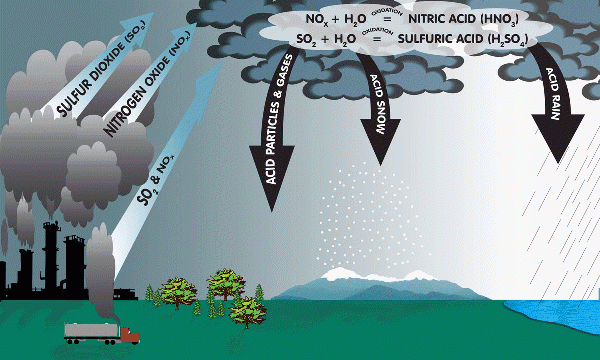
"SO2 and NO2 … particles can enter the lungs and cause lung disease, heart attacks, and ... asthma."
The reduction of acid rain in America and Europe was a environmental success story.
What happened?
Hard-won “international agreements, ... emissions limits on power plants, and ... reduced coal burning.”
Emission limits were accomplished by using SMOKESTACK “scrubbers”.
“In a ‘wet scrubber,’ the untreated exhaust is sent through a spray chamber
where fine water droplets knock down the harmful [SO2] particulates.”
Scrubbers are "expensive … it could cost more than ... $165 million to retrofit an existing facility.”
“While the major problem of sulfur dioxide was addressed [in Europe & America], other threats remain.
‘NOx in the air -- [from] car and truck exhaust -- also ... impact ... ecosystems and watersheds’.”
"’We still have more acidity in rain than we should have'."
Another problem with sulfur dioxide is global cooling. Nope, not a joke. :-{
Airborne SO2 prevents some sunlight from reaching the earth - resulting in somewhat cooler temperatures!
A 1974 “study warned that the greenhouse effect could become a major problem if improved
pollution-control measures reduced the countervailing cooling effect of small particles in the atmosphere.”
That’s right, with LESS sulphur dioxide, there’s MORE global warming!
SO2 has kept us a bit cooler, but it's no good: “Sulfur dioxide causes ... harmful effects in the lungs.”
We're "reaping the results of … our ‘Faustian bargain’ with [local] air pollution.
For decades, [localized] air pollution from [SO2] and ... other hazardous substances in fossil fuels
has had a strong temporary cooling effect on our climate.”
Sulfate aerosols created by "burning fossil fuels, reflect sunlight away ... and help cool the planet slightly.”
Since we began "to clean up the air, the [global] cooling effect ... has fallen by around 30 percent.”
The upshot is: we're going to have to double down on our global-warming-pollution prevention efforts!
======================================================================
Other Pollutants
Visit these links for information on the following toxic substances:
-
-
PFAS See the Investments and Profits page for more on PFAS
-
Visit the House page for information about home air and water filters.